Hilda C. Landers Library & Archives

  • About
    • Hours
    • Directions and Maps
    • People
    • Policies & Guidelines
    • Student Employment
  • Research Help
    • Get Research Help
    • Research Tools
    • Research Guides
    • Get Endnote
    • Cite your Sources
    • Subject Librarians
  • Services
    • Print, Scan, Copy
    • Computers and Software
    • Study Rooms
    • Accessibility
    • St. Mary’s Project Resources
    • Services for Faculty
    • Borrow, Renew, Request
    • Notary Public Services
  • Archives

Black History within Maryland – Spring 2026

March 4, 2026 by Stephanie Reyes

For the month of March, the library will be displaying a list of spaces within the state of Maryland that are markers of Black History, as well as related archival items. The display is located on the 1st floor of the library near the couches and public computers.

Our research team for this project consisted of student interns Keyshawn Morgan, Perla Bravo, Casper Kinzie, librarian Shane Moran, and Elisia Lewis. They worked to research the history and stories behind the monuments, spaces, museums, and archival items dedicated to African American heritage within the state of Maryland.

This year the library has refreshed our glass display cases on the first floor to feature items from the St. Mary’s College of Maryland Archives. Students (Perla Bravo & Casper Kinzie) and the College Archivist (Shane Moran) have specially curated items around people, places, and memories around Black and African American community members.

The archival items of display and their descriptions are the following:

Display Case #1 (near the sign)

Black History Month

Black History Month, c1989. SMCM Publications: Clippings, Subject Files, and Other Material, RG 08-16. Box 29, Folder 13. St. Mary’s College of Maryland Archives.

Africa for Americans Symposium Proposal Description: Conceived and directed by Michael Coy, Associate Professor of Anthropology at St. Mary’s, the series was supported by grants from the Maryland Humanities Council and the St. Mary’s College Foundation.

This series was divided into two weekends, on which there were different presentations designed to be digestible for the public of Southern Maryland and St. Mary’s College.

Black Student Union (BSU)

Black Student Union (BSU). VP Dean of Students: Student Development Office, RG 06-07. St. Mary’s College of Maryland Archives.

In the 1990s, the Black Student Union (BSU) created a newspaper used to connect students of all origins to the ongoing issues around the United States that affected the Black community. The BSU’s first newspaper, called “Crossroads,” was co-sponsored by the Office of Minority Affairs.

By the late 90s, the BSU launched their new newspaper, “Drum Talk.” “Crossroads” was converted to a communications board at the end of each “Drum Talk” issue.

Crossroads Newspaper

The first newspaper created by the Black Student Union and co-sponsored by the Office of Minority Affairs contained information mostly about on-campus issues, commentaries, and opinions.

The newspaper started with a section “From the Editor’s Desk.” This section provided an introduction to the newspaper and its purpose, plus messages from the Editor-in-Chief.

Lucille Clifton – Photographs

Photographs. Lucille Clifton papers, MSS-035. Box 5 Folder 7. St. Mary’s College of Maryland Archives.

Lucille Clifton was awarded a medal at the National Book Awards in 2000 for poetry for her book Blessing the Boats: New and Selected Poems 1988-2000. The book is seen as a compilation of her style and its development over time with many poems being of Clifton’s personal struggles and difficult topics presented.

(Photography, left to right Galway Kinnell, Lucille Clifton, Kinnell’s wife Barbara K. Bristol, and Dr. Michael Glaser, Professor Emeritus of English at St. Mary’s College of Maryland.)

Photograph 2 Description: Lucille Clifton visits Intensive Poetry Writing Workshop

Lucille Clifton was a distinguished Professor of the Humanities here at St. Mary’s College of Maryland from 1989 to 2005. She was a two time Pulitzer Prize finalist, second woman and first African American to be Poet Laureate of Maryland (1979-1985), and was the first African American to be awarded the Ruth Lily Poetry Prize.

As a professor at St. Mary’s, Clifton presented at multiple events on campus such as the “4 poets” (Oct. 1989) and “Women in Poetry” (March 1995) and was an honored speaker in the 2001 commencement ceremony alongside Dr. Edward T. Lewis, fourth President of SMCM.

Lucille Clifton – Poetry

“after the reading” and “february 11,1990 for Nelson Mandela and Winnie” signed by Lucille Clifton, 1990. Lucille Clifton papers, MSS-035. Box 1 Folder 9. St. Mary’s College of Maryland Archives.

The poem “february 11, 1990 for Nelson Mandela and Winnie,” published in Lucille Clifton’s collection Quilting: Poems 1987-1990 was written to honor the day of Nelson Mandela’s release from his 27 year imprisonment in South Africa.

Elizabeth Barber Interview

The Mulberry Tree, Spring 2001. SMCM Publications: The Mulberry Tree, RG 08-01. Box 3. St. Mary’s College of Maryland Archives.

An interview with Elizabeth Barber Walker, the first Black student to attend St. Mary’s College of Maryland (then St. Mary’s Junior College).

Elizabeth Barber was admitted to St. Mary’s Junior College in 1962. To avoid a rejection based on race, she submitted her application without listing her race, including the name of her high school, or sending a photograph.

Display case #2

Charles Ball Autobiography

Charles Ball, “Slavery in the United States; a narrative of the life and adventures of Charles Ball, a black man, who lived forty years in Maryland, South Carolina and Georgia, as a slave under various masters, and was one year in the Navy with Commodore Barney, during the Late War (Lewistown, Pa. : J. W. Shugert), 1836. Charles Ball Autobiography, MSS-098. St. Mary’s College of Maryland Archives.

The first edition of “Slavery in the United States; a narrative of the life and adventures of Charles Ball, a black man, who lived forty years in Maryland, South Carolina and Georgia, as a slave under various masters, and was one year in the Navy with Commodore Barney, during the Late War.”

Charles Ball was born in Charles County around 1780. His narrative details his experience as an enslaved person, as well as his service during the War of 1812. He is also one of three sailors depicted on the monument to the Battle of Bladensburg in Bladensburg, Maryland.

Genealogy Research: Lois Davis Genealogy Research

Lois Davis Genealogy Research. Lois Waters Davis Genealogy Papers, MSS-108. St. Mary’s College of Maryland Archives.

An extensive genealogical account of Black families in Charles County, Maryland. This binder contains decades of research done by the author to trace her roots and confirm the oral accounts of her family’s history given to her by her elder family members. It also reveals the history of Black education in Charles County; the author’s grandfather was responsible for the establishment of the first Black high school in the county.

An oral history of the author’s life and recollections will be available soon through the St. Mary’s College of Maryland Archives.

Regina Hammett Research

Regina Hammett – Black Schools, 1892-2002. Regina Hammett papers, MSS-015. Box 2 Folder 22. St. Mary’s College of Maryland Archives.

Regina Hammett, a two-time graduate of SMCM, conducted extensive research on Southern Maryland history. These are some of her raw research materials pertaining to Black schools and one-room schoolhouses. The data she found has been instrumental in the understanding and preservation of SoMD history. Her research shows evidence of the discrimination Black schools faced, including underfunding, overcrowding, and underpaid teachers. Hammett’s research, including her book, History of St. Mary’s County, Maryland, is the authoritative account of our local history.

“In relentless pursuit of an education : African American stories from a century of segregation (1865-1967)”

Unified Committee for Afro-American Contributions of St. Mary’s County, “In relentless pursuit of an education : African American stories from a century of segregation (1865-1967)” (Lexington Park, Md.), 2006. Collection on the Landscape of Slavery in Maryland, MSS-052. Box 1 Folder 11. St. Mary’s College of Maryland Archives.

Education opens many opportunities that would not otherwise be available, but was denied to Black Americans for many years. Even when schools were established to educate Black Americans, the segregated system led to schools that were underfunded compared to their white counterparts. This left the staff of these schools unable to provide a proper education for their students and the students struggling to retain the information due to poor conditions like excessive heat or excessive cold, or damaged materials. This book is filled with written oral accounts from students, staff, and parents who were involved in the education within these underfunded Black schools.

Education in St. Mary’s County

Citation: “Education in St. Mary’s County.” Dr. Robert E. King, Jr. St. Mary’s County Superintendent of Public Schools, 1973 March 1. Community Studies Conference: St. Mary’s County in the Year 2000 speeches, MSS-031. Box 1, Folder 5. St. Mary’s College of Maryland Archives.

Dr. Robert E. King, Jr. was the Superintendent of Public Schools for St. Mary’s County starting in 1958. During his tenure as Superintendent of Public Schools, St. Mary’s County fully integrated its school system. The first Black student to attend a St. Mary’s County public high school was Joan Elaine Groves, who attended Great Mills High School starting in 1958. Full integration of the St. Mary’s County public school system did not occur until 1967.

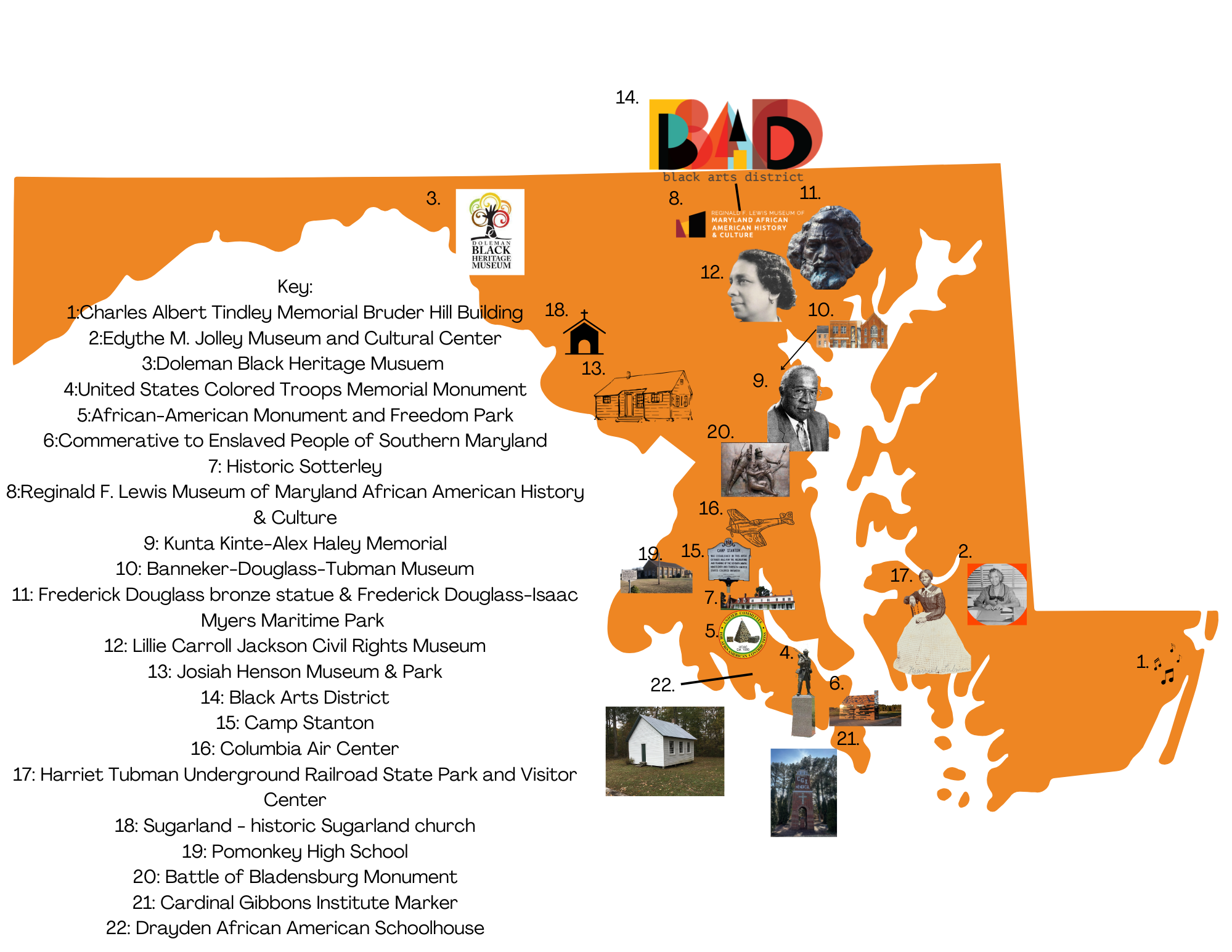
In addition to the archival items, we’ve updated the places within Maryland map. This map showcases places within the state of Maryland that have been built, curated, and highlight Black History:

Map of Maryland with different icons that pinpoint the locations of spaces and monuments that are dedicated to preserving and highlighting black history in Maryland. A list of 22 points in the key to the left.

Full list of spaces are at the end of this post with additional links and information.

Our monument and spaces research team is composed of our student intern Keyshawn Morgan and Library team member Elisia Lewis, they selected and researched 3 spaces out of the list to highlight:

African-American Monument and Freedom Park:
Location Lexington Park, Maryland

The African-American Monument and Freedom Park is dedicated to African-Americans and their contributions to the county from both past and present. It serves as a reminder for the citizens to know of such work that is to be recognized. A pyramid comprised of the oldest architectural structures built of stone and mortar, with four flags standing in front. The pyramid itself is surrounded by six pedestals with bronze plaques. At the top of the pyramid is a metal sculpture representing a flame.

Members of the UCAC made a proposal out to the St. Mary’s County Commissioners, with the intention to erect a monument that was dedicated to African-Americans. With the success of the agreement by the commission, the monument was to be placed alongside Tulagi Place, where there would also be a parking lot and a bus stop. Come July 29, 2000, the founders of UCAC rejoiced as the dream was made. Taking meetings into account to discuss the material that would used to create the structure of the monument we see today. The decision to be made, brought forth the outcome, which was to build the monument in the shape of a pyramid, similar to that of ones found in Egypt. Egypt is an African country, one that is known for its strength and endurance, being able to build pyramids using said strength, a symbol of eternal power.

The plaques: The monument is surrounded by six pedestals with bronze plaques inviting you into the monument to read and reflect on the monumental contributions of African-Americans to the county.

“Welcome to the African-American Monument of St. Mary’s County. This tribute to the unique contributions of African Americans in St. Mary’s County spans the following areas: religion, farming, trades domestic service, education, business, industry, community service, arts, entertainment, health, sports, government, politics, law enforcement, military service, and technology. It is fitting that monuments be build to solidify dignity and self-esteem… monuments that sing praises of love and encouragement to African-Americans and others. Embrace the strength and unity of the African American community! Build! Build monuments within and monuments without that reflect heritage, that create vision.”

  • Purpose: It serves as an external reminder to citizens of the county of the contributions of African Americans, which helped the growth and development of St. Mary’s County.
  • Depiction: A pyramid comprised of the oldest architectural structures built of stone and mortar, with four flags standing in front. The pyramid itself is surrounded by six pedestals with bronze plaques. At the top of the pyramid is a metal sculpture representing a flame.
  • Dedicated: July 29, 2000
  • Founders: Elmer J. Brown and the Unified Committee for Afro-American Contributions (UCAC)
  • Funding: By the Unified Committee for Afro-American Contributions (UCAC) and the St. Mary’s County Commissioners
  • Important Historical Figures: Elmer J. Brown, Richard Holly, Calvin Green, Tony Porter, Bob Lewis, Spencer Scriber, Joseph Stover, Philip Scriber, Melvin Endy, and many more!

Sources: Southern Maryland Equity in History Coalition -The African American Monument – Lexington Park;  Unified Committee for Afro-American Contributions

Commemorative to Enslaved People of Southern Maryland:
Location: Lexington Park, Maryland

The Commemorative to Enslaved People of Southern Maryland is to honor the story of strength and resilience of the lives of the enslaved individuals that once lived in St. Mary’s City. These lives are defined by creative problem solving, strength of character, and louds that echoed in freedom. Its depiction is a one-room cabin with a lighting system, which serves as a beacon of light. It was constructed with a steel framework clad with panels of polished mirror stainless steel and tropical hardwood. With the structure in mind, it stood against the test of time, and proudly stands before us to this day. The result is a stencil of light beams that portray and project the poetry on all sides of the monument.

Through the works of historical documents, archaeological research, and slave folklore, the Commemorative is an acknowledgement to the past while it honors enslaved people who once walked on the land in which we share. It re-contextualizes how we are to view our shared history. With the inclusion of erasure poetry to be displayed on the structure that uses a ghost frame as inspiration for its architecture, Historic St. Mary’s City provides an opportunity to change the dialogue around slavery in Southern Maryland.

Historical context: After the War of 1812, Americans were able to request reimbursement for any losses that occurred during the war. The archives at St. Mary’s College of Maryland include a deposition from the Brome Plantation, the land that is now St. Mary’s College, which was written by Robert Lilburn in 1821. Lilburn had written the piece about seven years after the war had ended. In the deposition, we can study more about former enslaved people of the plantation who self-emancipated by joining the British. The document says that in August 1814, “Admiral Cockburn landed at the home of Robert Lilburn with his men. And among them were two slaves, the property of John Mackall, named Harry Hammet and little Harry. The deponent asked them, ‘How did they like their new master?’ And they turned their backs on him and gave him no answer.” In another, the neighbors of Dr. Brome had a list of slaves, and among them are Harry Hammet and Harry Fox. This deposition says that about a few weeks after the slaves disappeared, British soldiers had arrived to the home of Benjamin Clocker and Susanna Bain, accompanied by the two former slaves Fox and Hammet. Harry Hammet raided and inspected the home under the authorization of Admiral Cockburn. These among bold acts of resistance are only a few examples of how the formerly enslaved had found redemption in their freedom, breaking free with a loud voice in society.

“A commemorative can be a reflective piece, but it can call you to action and make you think about something that is positive there. It can affect how you live your life going forward.”

-Former President Emerita Tuajuanda C. Jordan

  • Purpose: It is to honor the story of resilience and creative problem-solving that defined the lives of the enslaved individuals that once lived in St. Mary’s City.
  • Depiction: A one-room cabin with a lighting system that serves as a beacon of light. With the intention of standing the test of time, it was constructed with a steel framework clad with panels of polished mirror stainless steel and tropical hardwood. Its result is a stencil of light beams that portray and project the poetry on all sides of the monument.
  • Dedicated: October 31, 2020
  • Founders/Creators: Shane Allbritton and Norman Lee of RE:site studio and poet Quenton Baker.
  • Funding: By the State of Maryland, private donors, the Maryland Heritage Areas Authority, Maryland State Arts Council, and Dr. and Mrs. Jeffrey J. Byrd.
  • Important Historical Figures: John Mackall, Harry Hammet, Robert Lilburn, Harry Fox, Benjamin Clocker, Susanna Bain.

Sources: Maryland Office of Tourism; SMCM – Discovery of Slave Quarters; SMCM – About the Commemorative ; Atlas Obscura 

Cardinal Gibbons Institute Marker
Location: Ridge MD 20680

Residing inside of the Cardinal Gibbons Memorial Park, the Cardinal Gibbons Institute Marker memorializes St. Mary’s County’s first Black high school which opened in 1924 in Ridge, MD. The marker features an inscribed pyramid detailing the school’s history which sits inside the school’s original, exposed cupola.

Named after donor Catholic Archbishop James Cardinal Gibbons of Baltimore, the Cardinal Gibbons Institute blended religious teachings with vocational education, and its early curriculum was modeled after the Tuskeegee Institute’s as its first two teachers were Tuskeegee graduates. The school operated from 1924-1967, with temporary closure from 1933-1936, but it ultimately closed due to financial difficulties after desegregation. The Cardinal Gibbons Institute was demolished in 1972.

  • Depiction: A brick cupola originally from the structure (1924) labelled “C.G.I. Memorial” with a black, inscribed pyramid sitting on a brick post inside of the cupola.
  • Dedicated: September 1, 1990
  • Founders: Cardinal Gibbons Institute Memorial Committee, St. Peter Claver Church
  • Important Historical Figures: Archbishop James Cardinal Gibbons of Baltimore
  • Inscriptions:

    “In November 1916, three Catholic priests, Fathers LaFarge, Emerick, and Matthews met with blacks from St. Mary’s county to discuss their plans to have a national industrial school. In May 1917, land was acquired for this school. Archbishop James Cardinal Gibbons of Baltimore, Maryland donated $8,000 towards the purchase of this land. Consequently, the new school was named after the Archbishop – Cardinal Gibbons Institute. The Knights of Columbus National Board of Directors donated $38,000 towards the erection of the school building in February 1922. Archbishop Michael J. Curley of Baltimore, Maryland approved the general plans for the institute. Cardinal Gibbons Institute was opened in September 1924 and dedicated in October 1924. Victor H. Daniel was hired as the institute’s first principal and his wife, Constance, was hired as its assistant principal. The institute’s first graduating class held its commencement in June 1929.”

Sources: The Historical Marker Database; Southern Maryland Equity in History Coalition;

Full list of spaces notated on the image of the map:

  1. Charles Albert Tindley Memorial Bruder Hill Building
    • Location: Berlin, MD
    • Further information: Beach, Bays, & Water Ways: Dr. Charles Albert Tindley
  2. Edythe M. Jolley Museum and Cultural Center
    • Location: Cambridge, MD
    • Further information: The Mace’s Lane Community Center, Inc. (MLCC)
  3. Doleman Black Heritage Museum
    • Location: Hagerstown, MD
    • Further information: Doleman Black Heritage Museum
  4. United States Colored Troops Memorial Monument
    • Location: Lexington Park, MD
    • Further information: Visit St. Mary’s, SoMD News, SoMD Equity in History Coalition, Historical Marker Database
  5. African-American Monument and Freedom Park
    • Location: Lexington Park, MD
    • Further information: SoMD Equity in History, Unified Committee for Afro-American Contributions
  6. Commemorative to Enslaved People of Southern Maryland
    • Lexington Park, MD
    • Further information: SMCM: About the Commemorative
  7. Historic Sotterley:
    • Location: Hollywood, MD
    • Further information: Historic Sotterley: Common Ground
  8. Reginald F. Lewis Museum
    • Baltimore, MD
    • Further information: Reginald F. Lewis Museum
  9. Kunta Kinte-Alex Haley Memorial
    • Location: Annapolis, MD
    • Further information: Kunta Kinte-Alex Haley Foundation; Kunta Kinte-Alex Haley Memorial Annapolis; Alex Haley
  10. Banneker-Douglass-Tubman Museum
    • Location: Annapolis, MD
    • Further information: https://bdmuseum.maryland.gov/  https://www.eyeonannapolis.net/2024/10/banneker-douglass-museum-to-be-renamed-in-honor-of-harriet-tubman-on-november-1/
  11. Frederick Douglass bronze statue & Frederick Douglass-Isaac Myers Maritime Park
    • Location: Baltimore, MD
    • Further information: Frederick Douglass (Baltimore, Maryland), Frederick Douglass-Isaac Myers Maritime Park — Living Classrooms Foundation
  12. Lillie Carroll Jackson Civil Rights Museum
    • Location: Baltimore, MD
    • Further information: Official Website, Maryland State Archives, Baltimore Heritage
  13. Josiah Henson Museum & Park
    • Location: North Bethesda, MD
    • Further information: National Park Service-Josiah Henson, Washington Post- Uncle Tom’s Cabin, ZigerSnead Architects- The Planning of Josiah Henson Park, Josiah Henson Museum Park Official Site, Montgomery County Planning Board- Josiah Henson Park
  14. Black Arts District
    • Location: Baltimore, MD
    • Further information: Black Arts District
  15. Camp Stanton
    • Location: Hughesville, MD
    • Further information: Camp Stanton | VisitMaryland.org, Camp Stanton | Charles County Tourism
  16. Columbia Air Center
    • Location: Croom, MD
    • Further information: Columbia Air Center
  17. Harriet Tubman Underground Railroad State Park and Visitor Center
    • Location: Church Creek, MD
    • Further information: Harriet Tubman Underground Railroad National Historical Park (U.S. National Park Service)
  18. Sugarland – historic Sugarland church
    • Location: Poolesville, MD
    • Further information: Sugarland Ethno-History Project
  19. Pomonkey High School
    • Location: Indian Head, MD
    • Further information: The Historical Marker Database – Pomonkey High School, Charles County Public Schools: Pomonkey High School Alumni Association holds centennial celebration
  20. Battle of Bladensburg Monument
    • Location: Bladensburg, MD
    • Further information: Charles Ball Autobiography (see display cabinet), The Historical Marker Database
  21. Cardinal Gibbons Institute Marker
    • Location: Saint Inigoes, MD
    • Further information: Visit St. Mary’s, MD Website; Southern Maryland Equity in History Coalition
  22. Drayden African American Schoolhouse
    • Location: Drayden, MD
    • Further information: St. Mary’s County Government – Museum Division


Filed Under: Announcements, Exhibits, Web Resources Tagged With: announcements, featured, history, student workers

System Upgrade on Sunday, January 31, 2021

January 30, 2021 by Katherine Ryner

On Sunday, January 31, 2021, from 6 am to 6 pm 2 pm, USMAI systems will experience downtime due to a system upgrade.  

During this time there will be no access to the St. Mary’s Catalog or the USMAI Catalog, and there will be no off-campus access to any of our databases or e-journals.  

We apologize for the inconvenience!

Filed Under: Web Resources

Primary Source Database: AM Explorer

May 2, 2019 by Amanda VerMeulen

The St. Mary’s College of Maryland community now has access to over 60 significant collections of digitized archival material.

Adam Matthew Digital is a UK-based publisher of unique primary source material from leading archives and libraries around the world. Content spans the humanities and social sciences, from medieval manuscripts to 20th century global politics.

Adam Matthew provides access to all of their collection through one search engine called “AM Explorer.” Alternatively, you can access individual collections directly through the library’s A-Z Databases list.

Read on to learn about just a few of the collections available, some of the primary source materials they contain, and ideas for use in research and classes.

Colonial America

This collection features manuscripts and other documents from the National Archives (UK) from the early 17th through early 19th centuries. Content focuses on the early settlement of the colonies, American Indians, the American Revolution, legislation, trade, and the frontier–perhaps of special interest to local historians of St. Mary’s.

Maryland: Correspondence with the Secretary of State, 1688-1696: Addresses from Maryland to Their Majesties King William and Queen Mary: Council proceedings, 1693-1696 (Part 1), CO 5/718 Part 1

Highlight from the collection

Librarian Kent Randell, immediately upon finding out that the College has subscribed to AM Explorer, eagerly utilized this valuable resource and has already cited their Colonial History collections for his series of articles on the Susquehanna estate for the Maryland Genealogical Society Journal. Above is an excerpt of a memorandum regarding the case of Richard Smith, Jr., who was one of the most prominent Protestants to support the Catholic Third Lord Baltimore’s government until the “bitter end,” even after the Protestant Associators razed Lord Baltimore’s government in the Fall of 1689.  Richard Smith, Jr. refused to recognize the provisional rebel government and was imprisoned by the Protestant Associators, and above is an excerpt of a memo regarding his case prepared for the English Lords of Trade. Smith’s wife, Barbara (Morgan) (Rousby) Smith, traveled to England and successfully appealed to the Lords of Trade to have her husband removed from “gaol” (jail).

American Indian Newspapers

Forty-five digitized titles are available here, spanning around 200 years of U.S. history.  These newspapers include publications by tribal nations, students, and Christian missionaries in English and indigenous languages of the U.S. and Canada.  All of these papers are fully searchable and may allow for research contrasting the coverage and interpretation of events in indigenous versus mainstream publications.

Wassaja, May 1916, © The Newberry Library

Highlight from the collection

Indian School Journal was published by the Chilocco Indian Agricultural School from 1900-1980.  The monthly edition’s contents are the work of the Office of Indian Affairs (OIA), while the weekly edition was written by students.

Some of the issues provide a look into the everyday life, thoughts, and activities of the students, while others give insight into the OIA’s agenda.  Articles in the April 1906 issue, for example, seem to push assimilation as an imperative, bringing up negative stereotypes about the so-called blanket Indians, who remained committed to tribal traditions.  However, at times the articles directly respond to racist ideas with tongue in cheek humor; a mention of Comanche Chief Quanah Parker praises him as one good Indian who isn’t dead.

African American Communities

Focusing on communities in Atlanta, New York, Chicago, and North Carolina, the collection includes primary sources from the 19th and 20th centuries.  Researchers can find items including oral histories, newsletters, correspondence, family papers, and photographs. These materials may interest those studying race relations, housing problems, desegregation, the Civil Rights movement, and African-American culture and identity.

“All We Want is Freedom …”, n.d., © Kenan Research Center at the Atlanta History Center

Highlight from the collection

Interview with Kara Walker

The collection contains many video and audio oral history interviews, along with their transcripts.  Subjects include Quincy Jones, Koko Taylor Spike Lee, Gloria Naylor, and Cornel West. In this interview with visual artist Kara Walker, she describes the influence of artist Adrian Piper on her work, and the ways she uses silhouetted figures to interpret minstrelsy and romantic novels of the South.  Interviews may give viewers context for the work of the individuals highlighted, and a greater appreciation for the experiences shaping their lives and responses to overt and institutionalized racism.

Medical Services and Warfare

This collection gathers materials related to the Crimean War, the American Civil War and the First World War. The emphasis is on medical developments and their relationship to these conflicts, examining treatment during war and the influence in turn of war on medical breakthroughs.  Materials in this collection include clinical notes and medical records, correspondence, personal accounts, studies, military records, and the Florence Nightingale papers, containing handwritten letters that are searchable by keyword.

The Red Cross Magazine, Vol. 15, No. 5, May 1920, © Hoover Institution Library & Archives

Highlight from the collection

HMS Terrible: Medical and Surgical Journal, available in 3 volumes from 1853-1856

It may not surprise researchers to learn that life aboard the HMS Terrible was…difficult.  The Royal Navy ship, which fought in the Crimean War, records the health problems of its crew in this journal.  The ship’s surgeon tracked the name, age, role on the vessel, date, and outcome of the visit; i.e. sent back to duty, hospitalized, or occasionally, death.  The last pages of the journal give a tally of the incidents of particular medical issues, as well as offer the surgeon’s additional notes. Major culprits for infirmary visits include contusions (bruises), wounds, ulcers, phlogosis (inflammation), and rheumatism, with the most common communicable disease as syphilis.  Researchers may gain insight into the health of sailors aboard ships in the Crimean War, as well as sympathize with at least one soul sent to the hospital due to the severity of an ulcer on his foot.

Filed Under: Teaching & Education, Web Resources Tagged With: featured

Support & Solidarity for SMCM Students: Information & Resources

September 5, 2017 by Amanda VerMeulen

Support & Solidarity for SMCM Students: Information and Resources
http://libguides.smcm.edu/support-and-solidarity


Inspired by the Amherst College Library’s Amherst Uprising Information and Sources site, SMCM now has a Support and Solidarity mini-website where we can share:

  • all statements of support from departments, staff units, and student organizations on campus
  • resources on self-care and support for students
  • diversity, inclusion and anti-bias initiatives on campus, and how we can all get involved
  • resources for learning more about diversity, inclusion, and openness
  • and an anonymous form to suggest additional resources, organizations, and tools.

This is still a work in progress and will continue to evolve.

Filed Under: Library Collection, Web Resources Tagged With: announcements, support and solidarity

Films on Demand

March 6, 2017 by Amanda VerMeulen

Film Reel

You can’t beat the convenience of streaming video, and thanks to our subscription to Films on Demand, you can stream thousands (YES, THOUSANDS) of documentaries and educational films. Covering a wide breadth of disciplines, from Anthropology to Women & Gender Studies to the Sciences, Films on Demand provides full films and segmented clips that can be streamed from anywhere and even embedded into Blackboard and shared with others.

These are high-quality films from producers like the BBC, ABC News, PBS (including Frontline), California Newsreel, Films for the Humanities & Sciences and National Geographic, among others. All films are licensed for classroom use. So whether you want to share a documentary with your students or classmates, or just need to get a documentary fix on a Saturday night, check out Films on Demand.


Filed Under: Library Collection, Web Resources Tagged With: database, in the collection, movies

Database Page New Look

January 25, 2016 by Amanda VerMeulen

If you’ve been to the SMCM Library’s databases page in the last few weeks you’ve probably noticed some changes from the previous version.

Don’t stress! The new versions has all the same great features (and databases!) just in a slightly different format.

New database page layout

The main difference is the new version defaults to an A-Z list of allllll the SMCM Library databases. Want to find suggestions based on subject (like the old version)? Just use the “All Subjects” drop-down menu under the search bar.

Speaking of the search bar, you can easily go directly to your favorite database (*cough*JSTORE*cough*) by searching OR using the A-Z letter links near the top of the page.

As always if you have any trouble or questions, Ask Us by sending an email to ask@smcm.libasnwers.com or calling the Reference desk at 240-895-4272.

Filed Under: Web Resources Tagged With: database, featured, website

Film & Television Literature Index

May 18, 2015 by Amanda VerMeulen

Popcorn

Photo by charamelody on Flickr

Are you looking for film or television reviews? Or maybe you’re convinced that some scholar, somewhere, must have written a critical analysis of Mad Men (spoiler alert: they have).

Look no further than Film & Television Literature Index (with Full Text!) for this information and so much more. Using the standard EBSCOhost interface, Film & Television Literature Index is a fantastic database for film and television research. In addition to reviews and critical papers, you’ll find articles on cinematography, production, screenwriting, and preservation/restoration.

Explore Film & Television Literature Index now (or learn more about it).

Filed Under: Library Collection, Web Resources Tagged With: database, film, in the collection, reviews, television

JSTOR Daily: For All the JSTOR Fans

April 14, 2015 by Amanda VerMeulen

JSTOR DAILY ON IPADWe know there are die-hard JSTOR fans out there, and apparently, so does JSTOR. In an effort to merge current events with JSTOR-housed scholarship, everyone’s favorite archival scholarly database has created the JSTOR Daily, a magazine that publishes daily blog posts, weekly features, and a biweekly newsletter to “provide the backstory to complex issues of the day.”

It’s an interesting resource that could serve as a source of research ideas for students or even a teaching tool for faculty interested in finding links between news, current events, and academic scholarship. Take a look at some of their recent posts:

  • Is TV for Toddlers Really That Bad?
  • All the Young Dudes: Generic Gender Terms Among Young Women
  • What Role Did Laura Keene Play on Abraham Lincoln’s Last Night?
  • The Erotics of Backgammon

You can learn more about JSTOR Daily, subscribe to their biweekly newsletter, or follow them via RSS Feed, Facebook, or Twitter.

Filed Under: Web Resources Tagged With: announcements, jstor, magazine

Happy Birthday Rosa Parks

February 18, 2015 by Amanda VerMeulen

Rosa Parks

Rosa Parks in November 1956
Photograph: Photographer not identified/Library of Congress

February is Black History Month, and while we all take time to recognize and reflect upon our nation’s history, present, and future, we can also make Black History Month come alive thanks to the Library of Congress.  Today (February 4) would have been Rosa Parks’ 102nd birthday, and surely not by coincidence, an exhibit of her letters and photographs opens at the Library of Congress.

Selections from the 10,000 item collection will be available for public viewing on the first floor of the Library’s Thomas Jefferson Building from March 2 – 30, and then will be included in the current exhibition The Civil Rights Act of 1964: A Long Struggle For Freedom, which is open through September 12, 2015 on the second floor of the Thomas Jefferson Building.  Both exhibits are open Monday – Saturday from 8:30 AM – 4:30 PM.

Pictures of some of the items are available here from The Guardian (full article here) and just from these few pictures, the breadth of the collection is astonishing: there are images of poll tax receipts, a Presidential Medal of Honor, a pancake recipe, and even a letter complaining about not being allowed in the library.  Rosa Parks’ act of refusing to give up her seat on the bus is well-known throughout our country – it is rightfully regarded as a seminal moment in not only the civil rights movement, but the whole of U.S. history.  To be able to see her thoughts and words in her own handwriting provides a stark perspective of what led her to strike one of the first blows against Jim Crow.  Looking at and reading these documents allows us to appreciate the immense significance and courage of her actions – not just on that day in December 1955, but in the ensuing decades until her passing in 2005.

If you can’t make it up to D.C. to view the exhibit, fear not – the Library of Congress will be posting some of the collection online later this year.  And you can always check out some of the SMCM Library’s materials about Rosa Parks and the larger U.S. civil rights movement.

-Conrad Helms

Filed Under: Musings, Web Resources Tagged With: Black History Month, civil rights movement, library of congress, online archives, photographs, primary sources

LACMA’s Works of Art Online

May 14, 2013 by Amanda VerMeulen

Sous-Bois by Paul Cezanne, courtesy of the LACMA digital collection

Sous-Bois by Paul Cezanne, courtesy of the LACMA digital collection

Earlier this year the Los Angeles County Art Museum revamped their website to include a searchable collection of over 20,000 downloadable images of artwork in their collection that are in the public domain. These are high resolution images, folks! The quality is outstanding and the search interface is fantastic. In just 5 minutes I’ve manage to pull up Magritte’s The Treachery of Images (This is not a pipe), Renoir’s Two Girls Reading, and examples of 15th century Islamic calligraphy.

This is an excellent resource for art students, researchers, or simply art enthusiasts. Enjoy!

Filed Under: Web Resources Tagged With: art, images, LACMA, public doman

  • 1
  • 2
  • Next Page »

Recent Posts

  • Black History within Maryland – Spring 2026 March 4, 2026
  • Library Delayed Opening – February 23 February 22, 2026
  • Library Delayed Opening – February 2 February 1, 2026
  • Library Hours Update January 28, 2026
  • Library Closed – January 28 January 27, 2026

Categories

  • Announcements (29)
  • Archives (12)
  • Database Trial (8)
  • Events (57)
  • Exhibits (8)
  • Faculty and Staff Profiles (4)
  • Library Building (47)
  • Library Collection (61)
  • Library Ethnography Project (2)
  • Library Hours (96)
  • Library People (34)
  • Musings (34)
  • Services (31)
  • Student Employees (24)
  • Summer Reading (284)
  • Teaching & Education (2)
  • Uncategorized (1)
  • Web Resources (12)

Archives

Contact Us:

(240) 895-4264

ask@smcm.libanswers.com

47645 College Drive
St. Mary's City, MD, 20686-3001

Follow Us

  • Directions
  • Archives
  • Directory
Support the Library
White and Gold text reading 'The National Public Honors College' linking to the SMCM Homepage
St. Mary's College of Maryland
47645 College Drive
St. Mary's City, MD, 20686-3001

(240) 895-2000
Give Today

Next Steps

  • Request Information
  • Visit Campus
  • How to Apply
  • Explore SMCM

Just For You

  • Prospective Students
  • Current Students
  • New Students
  • Parents & Families
  • Faculty | Staff
  • Employment

Resources

  • InsideSMCM
  • Directory
  • Events | Newsroom
  • Hilda C. Landers Library
  • College Rankings
  • Translate
  • Digital Accessibility Plan
  • Brand Resources

St. Mary’s College of Maryland reserves the right to provide some or all of the course content through alternative methods of course delivery, including remote methods of delivery, and it reserves the right to change the method of delivery at any time before or during the academic term, in the event of a health or safety emergency or similar situation when it determines, in its sole discretion, that such change is necessary and in the best interests of the College and the campus community.

  • © St. Mary's College of Maryland
  • Consumer Information
  • Copyright
  • Privacy Policy
  • Title IX Compliance &Training
  • Report an Accessibility Issue
  • Non-discrimination Policy
  • Reporting Suspected Child Abuse and Neglect
  • OLA Fraud Hotline
  • Help Desk
  • Website Feedback
  • National Human Trafficking Hotline
  • 1-888-373-7888
  • BeFree Textline
  • Text HELP to 233733 (BEFREE)
  • More resources on human trafficking in Maryland